In one paragraph. What the burp leaves behind is the second paper in a series about a hypothetical sharp change in which space emerges from something more curled up. It works in a toy model of space as a network of dots and links. The toy is the paper's own: a close cousin of the published model called combinatorial quantum gravity, with one knob turned above the published value, and not that model itself. In the toy a curled tube changes all at once into a wider tube and gives off energy (the burp), and the change leaves small scraps. This paper counts them and reads what they are. One start leaves about one scrap, whatever the size of the tube. More starts leave more, but fewer than one each. The common scrap, a curled loop of four dots, heals away in warm surroundings and is frozen in when its surroundings cool. Cooled slowly enough, nearly all of them heal, yet most of the leftover energy stays, held by two rarer kinds of scrap that no cooling in these runs removed. Three predictions written down beforehand failed, and they are reported. A toy can show that a mechanism is possible or impossible within a class of models; that is the whole claim.
A sharp change rarely finishes the job. Ice that forms quickly traps bubbles. A crowd that leaves a stadium leaves coats on the seats.
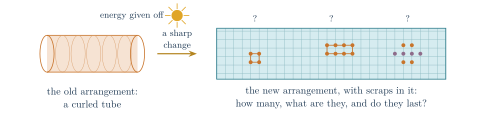
This paper is about what a sharp change leaves behind in a toy model of dots and links. The first paper in this series [1] found that a particular curled arrangement of the toy waits, then changes all at once and gives off energy. That paper named the release the burp. It also found that the change usually stops one small piece short of finishing. We call a leftover piece like that a scrap. Here we ask three questions about scraps: how many are left, what they are, and whether they last.
THE AUTHOR'S CLAIM The reason for asking is the author’s hypothesis that space emerged from something else by a sharp change, and that such a change leaves a remainder. She wants to test whether a remainder can last. Everything below is a test of that one question inside one toy. None of it is a measurement of the real universe.
Who is saying what
The project keeps four kinds of statement apart, and this edition tags them where it matters.
- EXACT Arithmetic, or a reading of a saved network link by link. True of the toy whatever a run does.
- MEASURED A simulation whose rules and predictions were written down before it ran, with its verdict. MEASURED, EXPLORATORY means a closer look at runs already read, with no prediction written first.
- PUBLISHED Other researchers’ published results.
- OUR READING, UNVERIFIED A reading of a result, offered by the author and her AI assistants and checked by no physicist. THE AUTHOR'S CLAIM The author’s hypothesis about reality, stated as hers.
Numbers in square brackets point to the sources listed at the end.
CHAPTER 1 · THE STORY SO FAR
A tube of dots that burps
What happens in a sharp phase change?
One arrangement gives way to another all at once and gives off energy, the way water gives off heat when it freezes. This chapter repeats, briefly, the sharp change the first paper studied in a toy model: a curled tube of dots that turns into a wider tube.
This chapter repeats, briefly, what the first paper established [1]. A reader who has that paper fresh can skip to Chapter 2.
The toy
PUBLISHED The toy is a network: dots joined by links, every dot holding exactly four links. It comes from a published model in which space is not a stage but an arrangement of such a network [2, 3, 4]. Four dots joined in a loop make a square. The toy gives every network an energy by counting squares, and the whole rule is a price list of two lines: a missing square costs 16 units, and a link that carries more than two squares pays extra for each surplus one.
The extra price is set by a number we call the knob. With the knob at 1 the toy is the published model. Every result in this paper has the knob at 1.25, where a surplus square costs 5 units. That setting is our addition, so this toy is a close cousin of the published model and not the model itself.
The toy changes by one kind of move, a swap: two links trade partners. A run is a long chain of swaps, each proposed at random and then accepted or refused.
The tube, and its burp
EXACT Wrap a square grid of dots into a tube only four dots around and join its ends. Every ring of four dots around the tube is itself a square, so every link around the tube carries a surplus square and pays for it. Call this the curled tube. It costs exactly 1 unit per dot more than an arrangement in which every link carries two squares, which costs nothing at all.
So a lower arrangement exists. But no single swap leads toward it: a swap either leaves the tube’s energy where it was or costs at least 12 units. The tube is stable for now. MEASURED, EXPLORATORY Given 12 units, every tube tested left, and with less none did. The change then spreads along the tube until every dot has been through it, giving off 1 unit for each dot. That release, and the event that gives it off, is the burp.
What the tube turns into
EXACT Here is the first paper’s least expected result. Read link by link, 98 of every 100 runs that finished with nothing left over had turned the curled tube into another tube. Its seam has slipped by two dots, so that going around it now takes six steps where it took four. Six around is the least a tube can be without paying for surplus squares, so the new tube costs nothing. Around every dot the squares fit together as they do on a flat sheet of graph paper, and we call an arrangement like that flat. Flat describes what a dot sees close by. It says nothing about how wide the tube is.
| A tube of 96 dots | what it costs | what it has given off |
|---|---|---|
| curled, four around | 96 units | nothing yet |
| after the burp, six around, no scrap | 0 units | 96 units |
| after the burp, six around, one common scrap | 14 units | 82 units |
The last line of that table is this paper’s subject. MEASURED In the first paper’s runs the change usually stopped one small piece short of finishing, leaving a scrap.
CHAPTER 2 · THE SCRAP
What a single change leaves behind
Is anything left over from before the Big Bang?
Nobody knows. In the toy model a sharp change usually stops one small piece short of finishing. This chapter says what that scrap is, and that a change started in one place leaves about one, whatever the size of the tube.
Read the wiring, not the count
A run reports numbers: how many squares, how many dots that look flat. It is tempting to name a shape from those numbers. This project has done that five times and been wrong five times. So every statement below about what a scrap is comes from reading a saved network link by link.
EXACT The common scrap is a closed loop of four dots, wired the way a ring of the old tube was wired: still curled. Each of its four links carries a third square. At our knob setting it holds 14 units, which is the burp of fourteen dots, held back. We call it a curled loop.

One push, about one scrap
To follow the energy to the last unit, the first paper sealed the toy in a box. EXACT A sealed run has no outside. Beside the network sit stores, each holding some units. A swap that costs energy is paid from a store, and a swap that gives energy off pays into one. Network plus stores never changes, and that was checked in every run. With two stores for every dot, the burp spreads so thin that the box stays cold.
MEASURED Eighty tubes were sealed in cold boxes, twenty each at 64, 96, 192 and 288 dots, and each was given one 12-unit push, so that the change began in one place. We call a place where the change begins a start. The prediction written down beforehand was that a longer tube leaves more scraps. It does not. The count was 0.90, 0.85, 1.05 and 0.95 scraps per tube.
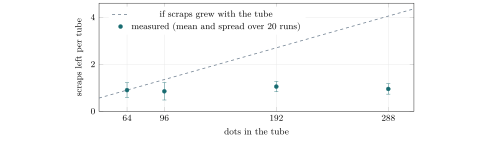
MEASURED A second test asked where the scrap sits. Two guesses were written down: at the place the change started, or at the far side, where the change spreading both ways around the tube would meet itself. It sits at neither. Its position is spread evenly along the tube.
MEASURED, EXPLORATORY In 9 of the 80 boxes the leftover was not a curled loop. It was a different object holding 20 units, which the first paper called a twist. It comes back in Chapter 7.
CHAPTER 3 · MORE STARTS
Does every start leave a scrap?
How do defects form when a material changes phase?
A change that starts in many places at once does not always finish cleanly. In the toy model more starting places leave more scraps, though fewer than one each.
A change in a large space need not start in one place. So the next question is what several starts leave.
Starts planted by hand
From each start the change spreads both ways along the tube. The moving edge between changed and unchanged tube is a front, and where two fronts meet, two changed stretches join.
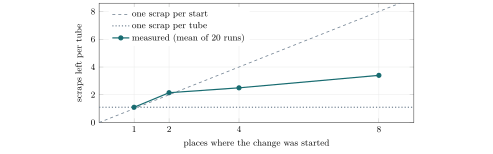
MEASURED A tube of 384 dots was sealed in a cold box, and the change was started by hand at one, two, four or eight evenly spaced places, twenty runs each. The author’s hypothesis fits one scrap per start. Our own guess leaned toward one scrap per tube, however many starts. Neither held.
Tubes that start themselves
Nobody plants starts in a large space. To see what a tube does on its own, we need the other way of running the toy.
PUBLISHED Instead of a sealed box, picture the network sitting in a bath that lends it energy for a swap that costs and takes back what a swap gives off. The bath is endless. One number sets how freely it lends, and we call that number the warmth. In a warm bath costly swaps happen often. In a cold one they almost never do. Time in a run is counted in sweeps: one sweep is two proposed swaps for every dot.
In a bath the curled tube needs no push. Sooner or later the bath lends the 12 units somewhere, and the change starts there. In a long tube it starts in several places before any one change has crossed the tube.
MEASURED Tubes of 256 to 4,096 dots were left in baths at three warmths. Three predictions written down beforehand held: longer tubes start in more places, the changed share grows over time the way the textbook law for changes that start at random places and spread says it should [7], and longer tubes are left holding more energy.
MEASURED A later, larger test let tubes of 512, 1,024 and 2,048 dots start themselves at the coldest of those warmths and counted the curled loops left when the change was over.
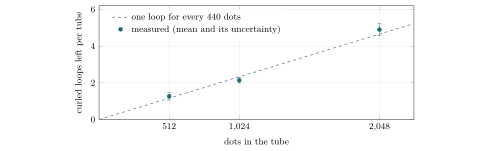
So the single scrap of Chapter 2 is what a single start leaves. A tube long enough to start in many places leaves scraps in proportion to its length.
A warning about warm baths
MEASURED The longest tubes in the two warmest baths did something else. More than half of their dots ended with too few squares around them, and the tubes had taken in about twice as much energy from the bath as a burp gives off. That is melting: the bath breaks squares faster than the toy re-forms them, and the network ends up linked any old way. EXACT A sealed tube cannot melt. Its own burp holds enough energy to break at most one square in sixteen. Melting needs energy from outside.
CHAPTER 4 · WARMTH
Does a scrap last if its surroundings stay warm?
Do defects heal over time?
In warm surroundings the toy's common scrap does. This chapter holds one in a bath at three warmths and times how long it lasts.
MEASURED New tubes of 96 dots were changed in cold sealed boxes, and those left holding exactly one curled loop were moved into a bath and held at one warmth for 100,000 sweeps. Three warmths were tried. Three outcomes were written down beforehand: the scrap wanders, or it heals in the warmer baths and stays in the colder, or it stays everywhere. To heal means that the scrap’s dots rearrange into the flat pattern around them and its energy is given off.
It healed at every warmth.
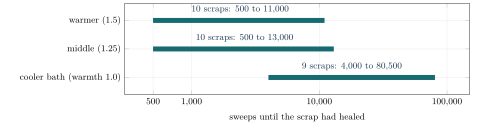
MEASURED Two things about how it healed. Each tube held one scrap, so each scrap healed by itself, with nothing to meet. And 27 of the 29 were never seen to move first. A curled loop mostly sits where it is until it is gone.
In the cold sealed boxes of Chapter 2, by contrast, every scrap lasted the whole run.
CHAPTER 5 · THE RACE
What if the surroundings cool down?
What does it mean for something to freeze in as the universe cools?
A leftover freezes in when its surroundings get too cold to heal it before it has healed. This chapter runs that race in the toy, one scrap at a time.
Warm surroundings heal a scrap and cold ones keep it. Reality cooled as it expanded. So what matters for a remainder is a race: does the scrap heal before its surroundings get too cold to heal it?
MEASURED Tubes of 96 dots, each holding one curled loop, were put in a bath at warmth 1.25, where the last chapter saw every scrap heal within 13,000 sweeps. The bath was then cooled, in equal steps, to a warmth of 0.25, where no swap is ever accepted, and held there. The cooling was spread over anything from 300 to 100,000 sweeps. The verdict written down beforehand was freezes in if some cooling time keeps most scraps and the fastest cooling keeps the most.
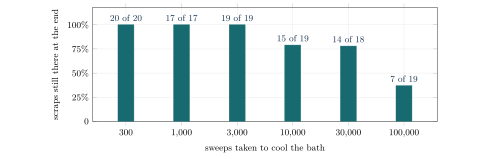
It freezes in. Even a cooling of 30,000 sweeps, more than twice the longest healing time at the starting warmth, kept most scraps, because the bath leaves the range where healing is quick early in the cooling. The scraps that healed did so in the first 15,000 sweeps.
MEASURED The author’s prediction was that it would freeze in. It was written down for her from what she had said, and she confirmed it as hers only after the result was in, so it does not count as a prediction made beforehand. Ours was made beforehand: that it freezes in, and that cooling slower than 1,000 to 10,000 sweeps would lose most scraps. The first half held. The second was wrong by a factor of three to thirty.
CHAPTER 6 · THE LARGE TEST
Many scraps, cooled slowly
Does cooling slowly remove defects?
Mostly, in the toy: cooled slowly enough, nearly all of the common scraps heal. But most of the leftover energy stays, and this chapter shows what the slow cooling did not touch.
The last three chapters used small tubes and one scrap at a time. This chapter puts the pieces together: tubes large enough to start themselves in many places, left with several scraps each, and then cooled.
A fair clock
One thing has to be fixed first. A swap needs two particular links to be picked together. In a network ten times larger, any particular pair is picked a tenth as often in a sweep. So anything local, like a scrap healing, takes more sweeps in a bigger network for no reason but bookkeeping. To compare sizes we count time in fair sweeps: sweeps scaled so that each small neighborhood gets as many chances as it would in a 96-dot network. At 1,024 dots one fair sweep is about eleven sweeps.
The test
MEASURED Eighty tubes of 1,024 dots were left in a bath at warmth 1.25 until the change was over. Each finished tube was then copied, and the copies were cooled at seven speeds, from an instant chill to a cooling spread over 300,000 fair sweeps. So every cooling speed began from the very same tubes. The slowest cooling used the first forty.
The question written down beforehand was the shape of the fall. Does each tenfold slowing of the cooling lose a steady fraction of the curled loops (a gentle fall), or does the count hold and then collapse (a cliff)? The author predicted a gentle fall. So did we.
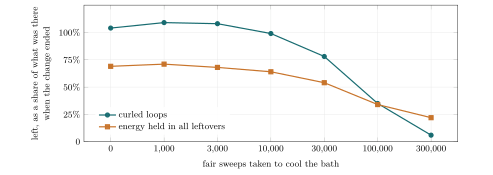
A cliff. Both predictions failed.
The energy that stays is not in the curled loops
MEASURED If curled loops were the only leftovers, the energy held in leftovers would have fallen with them. It did not. After the slowest cooling, 6 curled loops in 100 were left, and 22 units in 100 of the leftover energy. Something else was holding energy, and cooling slowly did nothing to it.
Two checks on the test itself
MEASURED The fair clock made a prediction of its own: counted in fair sweeps, the 1,024-dot tubes should lose their curled loops at the same pace the 96-dot tubes of Chapter 5 did. At one of the two points checked they lost them sooner, by more than the margin allowed. So the fair clock is a better ruler than plain sweeps and still not an exact one. The second check held: at one cooling speed, tubes of 512, 1,024 and 2,048 dots kept the same number of curled loops for their length.
Why we went here. Chapters 4 and 5 said a scrap heals in warmth and freezes in when cooled. That left the question that matters for a remainder: across many scraps, how much is frozen in, and how does that depend on the speed of cooling? The answer was not the one predicted, and it pointed at leftovers nobody had looked at.
CHAPTER 7 · A CLOSER LOOK
What are the pieces that stay?
What kinds of defect can a sharp change leave?
In the toy, three, read link by link: a curled loop, a double loop and a twist. Each is stuck on its own, and none is a seam between regions.
Three guesses, written down first
Before anyone read the pieces of two and of eight, three guesses about them were written down, with a test for each.
- A scar: damage that one swap would mend, if the bath ever offered that swap. The test: is there a single swap that removes the piece and lowers the energy?
- A seam: the stitching where two stretches of new tube, grown from different starts, met and did not match. The test: does the piece hold a link joining two places that are otherwise far apart?
- Stuck on its own: a small arrangement that sits in a dip of its own, so that every swap out of it costs energy. The registered name for this guess was KNOT.
The author predicted a seam.
EXACT All 600 saved tubes were read link by link. Not one piece of any size can be mended by a single swap. Of 2,121 pieces, 4 hold a far-reaching link. MEASURED The verdict was the third guess: stuck on its own. The author’s prediction failed.
Three kinds of scrap
EXACT Read from the wiring, the leftovers are three objects.

| Scrap | what it is | holds | cheapest swap out |
|---|---|---|---|
| curled loop | one ring of the old tube, still curled | 14 units | costs 12 |
| double loop | two rings of the old tube, still curled | 8 units | costs 11 |
| twist | eight dots of two kinds | 20 to 30 units | costs 11 |
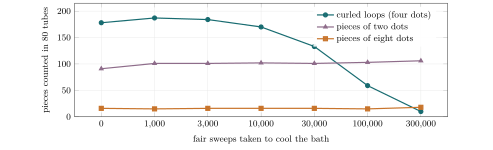
The double loop is eight dots wired as a short stub of the old tube, two rings long. The twist is eight dots of two kinds. Four of them, in two linked pairs, have a square too many around them, as the dots of a curled loop do. The other four, also in two linked pairs, have a square too few. The count of leftover pieces in the last chapter split each twist into four pieces of two dots, which is why so many pieces of two appeared. OUR READING, UNVERIFIED The 20-unit twist that turned up in 9 of 80 boxes in Chapter 2 is the same kind of object. Whether it is wired exactly the same has not been settled.
The same first step, a different fate
EXACT The cheapest swap out of a curled loop costs 12 units. The cheapest swap out of a double loop or a twist costs 11 in nearly every one read. Those are nearly the same. Yet the curled loop heals when cooled slowly and the other two do not.
OUR READING, UNVERIFIED So the first step cannot be what decides. What decides must lie further along: after the first costly swap, a curled loop must have a way downhill to the flat pattern, and the other two must not have one within reach. Nobody has traced those paths. Until someone does, this paragraph is a guess.
Why we went here. A leftover named from a count has been wrong five times in this project. The pieces that survived cooling were going to carry the paper’s main result, so they were read from the wiring before they were named, with the guesses and their tests written down first.
CHAPTER 8 · WHERE SCRAPS SIT
A scrap can be the joint between two widths
Why do some defects never heal?
One possible reason, seen in old runs and not yet tested: a scrap can be the joint between two stretches of different width, and a joint may not be removable while the widths differ.
The author’s guess in the last chapter was that leftovers are seams: what is left where two stretches of new tube met. As tested, by looking for a far-reaching link, that failed. A reading made three days later suggests it may be right in a different form.
The new tube does not have to be six around
EXACT Chapter 1 said the curled tube turns into a tube six around, its seam slipped by two dots. The seam can slip further. Slip it by four and the tube is eight around. Slip it by six and it is ten around. Every one of those costs nothing, because the toy charges for loops of four dots and for nothing longer. So the toy has many arrangements of zero energy, and it has no preference among them.
MEASURED, EXPLORATORY The first paper saved the final network of 11,880 runs. In 2,014 of them the change had finished with something left over. Those were read again, looking only at dots far enough from any leftover to see clean flat pattern all around them.
| Of 2,014 finished runs with something left over | runs |
|---|---|
| at least one stretch wider than six around | 960 |
| a stretch six around and a wider stretch | 440 |
| of those, the two stretches touch directly | 0 |
EXACT In all 440, a leftover lies between the stretch that is six around and the wider one.
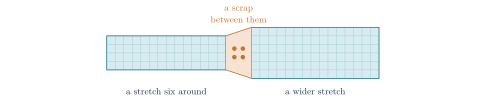
OUR READING, UNVERIFIED So some scraps are not strays inside one uniform tube. They are the joint where a narrower stretch meets a wider one. A joint like that may not be removable at all while the two stretches keep different widths, which would be a reason for a scrap to last that has nothing to do with cooling. That is a reading of old runs, made after the fact. Which of the three kinds of scrap are joints has not been read. Before it counts, it needs its own prediction and fresh runs.
CHAPTER 9 · WHAT WE HAVE LEARNED, AND WHAT COMES NEXT
The remainder that lasts is not the common one
Could something left over from the birth of space still be around?
This paper cannot say. It shows which leftovers last in one toy model, lists the three predictions that failed, and says what has to be computed next.
What is established in the toy
A sharp change in this toy leaves small scraps of three kinds, each stuck on its own. One start leaves about one. More starts leave more, though fewer than one each, and a tube that starts itself leaves them in step with its length. A lone curled loop heals in any warm bath and is frozen in by cooling. Among many scraps, slow cooling removes the curled loops and leaves the double loops and twists, which hold most of the energy that stays.
OUR READING, UNVERIFIED For the question the author wants tested, whether a remainder can last, the toy’s answer has a twist of its own. The scrap everyone counted first is the one that goes. The ones that last are rarer, and over the range we ran, how many there are depends on how the change started and not on how slowly its surroundings cooled.
What this does not show
- Anything about the real universe. A sweep of the toy is a bookkeeping step, and nothing ties it to a clock in the sky.
- That double loops and twists never heal. The slowest cooling took 300,000 fair sweeps. A slower one might remove them.
- A law for how leftovers fall with cooling time. Seven cooling speeds are enough to tell a cliff from a gentle slope and not enough to write a formula.
- That the list of three kinds is complete, or that scraps behave the same way when the toy has three large directions to work with instead of one.
Three predictions that failed
MEASURED They are part of the result. Scraps were predicted to grow with the tube, and they do not (Chapter 2). The curled loops were predicted to fall gently with slower cooling, by the author and by us, and they fall off a cliff (Chapter 6). The leftovers that survive were predicted by the author to be seams, and by the registered test they are not (Chapter 7).
This has been studied before, in other materials
PUBLISHED People who study how order forms in materials have names for nearly everything in this paper. A change that starts at scattered places and spreads is nucleation and growth. A scrap is a defect. Healing is annealing. A system sealed with its energy is isolated, and one whose defects stop moving is arrested. A recent study of a sealed chain of atoms finds outcomes with the same outline as ours: order that spreads from scattered starts, and defects that either slowly disappear or freeze where they are [8]. OUR READING, UNVERIFIED The differences matter as much. Their defects are borders between two mirror-image versions of one pattern, and they vanish only in pairs. A lone curled loop heals by itself. And their sealed chain follows the laws of motion, where our toy follows a rule for trying swaps. The technical paper uses their vocabulary so that people from that field can check the work.
What comes next
Trace the path. The first costly swap is the same for the scrap that heals and the scraps that stay. The next step is to list, swap by swap, every route from each kind of scrap to the flat pattern, and find the lowest pass on any of them. That is an exact calculation, with no chance in it.
Test the joint. Chapter 8’s reading becomes a prediction: in fresh runs, scraps that sit between two widths should outlast scraps that sit inside one.
A rule that pays for width. The first paper ends with a new price, on loops of six dots, which makes tubes go on widening past six around. MEASURED In those runs the wide result was full of flaws, with nine dots in ten having one within three steps. There the leftovers are no longer a rare remainder. They are the main thing standing between the toy and a clean wide space, and that is the subject of a later paper.
The scrap we counted first is the one that heals. What holds the others in place?
Continuing into the technical paper
This edition follows the technical paper [13], which holds the tables, the uncertainties and the full references. Every number above is taken from it or from the project’s record. Its sections run in a different order from the chapters here, because it describes the three kinds of scrap first and this edition meets them in the order they were found: the model (Chapter 1), the kinds of relic (7), one seed (2), how many (3), lifetime in a bath (4), cooling (5 and 6) and the discussion (8 and 9).
A few translations for the next step
| In the paper | What to keep in mind |
|---|---|
| “The model” | In the technical paper, our toy: the published model with the knob λ at 1.25. Only λ = 1 is the published model, combinatorial quantum gravity. |
| N, L | N is the number of dots. A 4 × L torus is the curled tube: four around and L rings long, so N = 4L. |
| λ and g | Lambda is the knob. g is the bath’s warmth. People who study materials use both letters for other things, and the technical paper warns them. |
| d | The square-count signature: how many of the six pairs of links at a dot close no square. 2 where the pattern is flat, 1 on the curled tube, 3 where a square is missing. |
| Relic | A scrap. |
| Column | A curled loop: one ring of the old tube still curled. |
| Double column | A double loop. |
| Knot of two kinds | A twist. |
| Seed, nucleation | A start: a place where the change begins. |
| Domain | A stretch of the new arrangement grown from one start. |
| Anneal | Heal. |
| Isolated, microcanonical | Sealed: total energy fixed, nothing in or out. |
| External bath | The bath of Chapter 3, as opposed to the stores inside a sealed box. |
| Arrested | Frozen in: the scrap can no longer move or heal because nothing can pay for the swap. |
| Size-fair sweeps | Fair sweeps. |
| Apparent exponent | A slope read off a short stretch of a curve, which need not hold beyond it. |
| Pre-registered | The prediction and the rules of the test were committed before the run. |
Where the evidence is recorded
The technical manuscript is in the project repository, with every configuration, random seed, result file and prediction. Experiment labels in that record: T10 and T11 (one start, and where the scrap sits), T17 (planted starts), T37 (tubes that start themselves), T19 (warm baths), T25 (cooling one scrap), T51 (the large test) and T55 (the three guesses). The reading of Chapter 8 is entry O116 of the project’s list of findings.
Disclosure
The author used Claude (Anthropic) and ChatGPT/Codex (OpenAI) to assist with code, analysis and writing, and is responsible for the result. This edition was drafted with Claude from the technical manuscript and the project’s record. Its comparisons and pictures introduce no new experiments or evidence. No physicist has reviewed any of it.
Sources
- E. Smith, The curled torus burps: activated escape and conversion in a graph model of emergent geometry, technical manuscript and plain-language edition (2026), in the project repository.
- C. A. Trugenberger, Combinatorial quantum gravity: geometry from random bits, J. High Energy Phys. 09 (2017) 045, arXiv:1610.05934. Cited as in the technical paper.
- C. Kelly, C. A. Trugenberger, and F. Biancalana, Self-assembly of geometric space from random graphs, Class. Quantum Grav. 36, 125012 (2019), arXiv:1901.09870.
- C. A. Trugenberger, Networks as the fundamental constituents of the universe, J. Phys. Complex. 6, 042001 (2025), arXiv:2512.17676.
- C. A. Trugenberger, Dark matter and dark energy in combinatorial quantum gravity, arXiv:2409.09385 (2024). Cited in the technical paper only.
- M. Creutz, Microcanonical Monte Carlo simulation, Phys. Rev. Lett. 50, 1411 (1983). The method behind the sealed box. Cited as in the technical paper; we have not read it.
- A. N. Kolmogorov (1937); W. A. Johnson and R. F. Mehl (1939); M. Avrami, J. Chem. Phys. 7, 1103 (1939). The textbook law for a change that starts at random places and spreads. We have not read the originals.
- H. Jang and G.-W. Chern, Suppressed coarsening after an interaction quench in the Holstein chain, arXiv:2602.05815 (2026).
- H. Jang, Y. Yang, and G.-W. Chern, Anomalous coarsening and nonlinear diffusion of kinks in an one-dimensional quasi-classical Holstein model, arXiv:2512.07744 (2025). Cited in the technical paper only; read in part.
- Y. Fan, S. Zhang, and G.-W. Chern, Machine learning nonequilibrium phase transitions in charge-density wave insulators, arXiv:2601.07583 (2026). Cited in the technical paper only; read in part.
- A. del Campo and W. H. Zurek, Universality of phase transition dynamics: topological defects from symmetry breaking, Int. J. Mod. Phys. A 29, 1430018 (2014), arXiv:1310.1600. Cited in the technical paper only; read in part.
- A. Bora, S. S. Bakshi, H. Jang, and G.-W. Chern, Cooperative domain-wall dynamics in a two-dimensional quasiclassical Holstein model, arXiv:2609.28436 (2026). Cited in the technical paper only; read in part.
- E. Smith, What the burp leaves behind: relic defects of fixed size in a graph model of emergent geometry, technical manuscript, draft of 13 October 2026, in the project repository.
Sources 1 to 12 carry the same numbers as in the technical paper [13]; 13 is this edition’s own.
The big questions, and what this work can honestly say
Is anything left over from before the Big Bang?
Nobody knows, and this work does not settle it. It tests one part of a hypothesis, the author's: that space emerged from something else by a sharp change, and that such a change leaves a remainder. She wants to test whether a remainder can last. In a toy model the common leftover heals away unless its surroundings cool, and two rarer kinds lasted through every cooling tried. That is a result about a toy, not evidence about the real universe.
What is a relic, in physics?
Something made in an earlier era that survives into a later one. This paper studies relics of a toy model only: small arrangements of dots and links left behind when a curled arrangement changes sharply into a flatter one.
Do defects from a phase change last forever?
Not necessarily. In the toy the common defect heals in any warm surroundings and survives only if its surroundings cool first. Two rarer kinds were still there after the slowest cooling these runs could afford, which is not the same as lasting forever.
Is this an accepted theory?
No. It is a hobbyist's hypothesis, tested on a toy model with the predictions written down first, written with AI assistance and not yet reviewed by a physicist. The paper says exactly what was and was not shown.
Quick answers
What is “What the burp leaves behind” about?
It is a plain-language edition of a computational physics paper by Emily Smith, the second in a series. The first paper found that a curled arrangement in a toy model of dots and links changes all at once and gives off energy. This one asks what that change leaves behind: how many leftover pieces, what they are, and whether they last.
What is the burp?
The energy given off when the toy's curled tube changes into a wider one: one unit for every dot at the paper's setting. The name comes from the first paper in the series.
What is a scrap?
A small piece left over when the change stops short of finishing. Read from the wiring there are three kinds: a curled loop of four dots holding 14 units, a double loop of eight dots holding 8, and a twist of eight dots of two kinds holding 20 to 30.
How many scraps does a change leave?
A change started in one place leaves about one, whatever the size of the tube, from 64 to 288 dots. Started by hand in one, two, four or eight places it left 1.10, 2.15, 2.50 and 3.40 on average: more starts, more scraps, but fewer than one each. A tube long enough to start itself in many places left about one curled loop for every 400 to 480 dots.
Do the scraps last?
The common one, the curled loop, heals away in every warm bath tried, in 500 to 80,500 sweeps of the simulation. If the bath cools first it is frozen in. The double loop and the twist were unchanged by every cooling run, the slowest lasting 300,000 size-fair sweeps; whether a slower one would remove them is not known.
What happened when many scraps were cooled slowly?
The curled loops fell off a cliff: slowing the cooling from 10,000 to 100,000 fair sweeps lost two in three, and from 30,000 to 300,000 lost twelve in thirteen. The energy held in leftovers fell much less, from 4.3 percent of the burp to 1.3 percent, because the other two kinds stayed.
Which predictions failed?
Three. That scraps would grow with the size of the tube. That the curled loops would fall gently as the cooling slowed, predicted by the author and by her AI assistants. And that the leftovers which survive cooling would be seams between regions, predicted by the author. All three are reported in the paper.
What is combinatorial quantum gravity, and is this it?
Combinatorial quantum gravity is a published model, built by Carlo Trugenberger, Christy Kelly and Fabio Biancalana, in which space is a network with no positions at all and the energy is a count of squares that acts as a curvature. This paper's toy is a close cousin of that model, not that model itself: it turns one knob, the price of a surplus square (λ), above the published value of 1.
Does this show what is left over from the birth of the universe?
No. A toy can show that a mechanism is possible or impossible within a class of models; that is the whole claim. The clock in the simulation is a sampling rule, not physical time, and no physicist has reviewed the work.
Was AI used to write this?
Yes. The author used Claude (Anthropic) and ChatGPT/Codex (OpenAI) to assist with code, analysis and writing, and is responsible for the result. The predictions for the main tests were written down before the runs.
What this page is about
what is left over from before the Big Bang, relic defect, defects after a phase transition, nucleation and growth, annealing, freeze-out, dynamical arrest, emergent spacetime, combinatorial quantum gravity, graph model of space, metastable state, isolated system (microcanonical), pre-registration, Markov chain Monte Carlo.
Sign the guestbook
Leave a note, a question or a correction. The guestbook runs on e-mail, as in 1996: the button opens your mail program with your entry filled in, and you press send.
Your address is used only to reply to you and, if you tick the box, to tell you about the next paper. Or skip the form and write to emilysmithcreate@gmail.com.
How to cite this page
Emily Smith, What the burp leaves behind: How many scraps a sharp change leaves, and which of them last (plain-language edition), 13 October 2026. https://sidenerdapps.com/mainnerd/02whattheburpleavesbehindPL/
@misc{smith2026burpleavesbehind,
  author = {Smith, Emily},
  title  = {What the burp leaves behind: How many scraps a sharp change leaves, and which of them last},
  year   = {2026},
  month  = oct,
  note   = {plain-language edition},
  url    = {https://sidenerdapps.com/mainnerd/02whattheburpleavesbehindPL/}
}